
 English
 Français
 Español

How to Use Ratchet Tie Down Straps Correctly: A Step-by-Step Guide
2026-08-07
What Is a Ratchet Tie Down Strap and How Does It Work?
A ratchet tie down strap is a two-piece cargo securing device. One end is a long polyester webbing with a fixed hook; the other end is a shorter strap assembly that includes the ratchet mechanism and a second hook. The ratchet itself is a gear-and-pawl system inside a metal housing. When you pump the handle, the pawl locks into the gear teeth, allowing the mandrel to rotate in only one direction. This incrementally pulls the webbing tighter with each stroke, creating much higher tension than a friction-based cam buckle can achieve.
The webbing is almost always made from polyester, not nylon. Polyester has lower stretch, better UV resistance, and less water absorption, which means it holds tension longer and resists weather-related weakening. A well-designed ratchet mechanism reduces the effort you need to apply. For example, wider handles and improved gear geometry—something we refine through extensive fatigue testing—can make a noticeable difference in real-world use. For a deeper look at how mechanism design affects loading efficiency, see our explanation of ratchet mechanism improvements. If you are new to the safety side of things, you might also review how to use a ratchet strap safely before your first operation.
Before You Start: Safety Inspection Checklist
No amount of technique can make up for damaged equipment. Inspect every component before each use. If any single item fails, take the strap out of service immediately.
- Check the webbing along its full length for cuts, abrasions, burn marks, or significant fading. Surface fuzz is normal, but broken fibers are not.
- Examine all stitching. Loose, broken, or missing stitches around the hook area or ratchet body indicate the strap has been overloaded or aged beyond safe use.
- Test the ratchet mechanism by opening and closing the handle a few times. It should move freely without sticking. Look for rust, cracks, or bent metal.
- Inspect both hooks. A hook that is bent open, cracked at the throat, or has a deformed latch must be replaced.
- Confirm the tag is present and legible. You must know the Working Load Limit (WLL) for the strap you are using. Never guess.
These checks are not one-time formalities. Commercial operators typically follow structured daily inspection protocols, which align with broader industry standards. You can read more about the regulatory side in our guide to daily inspection and scrapping standards.
Step-by-Step: How to Use a Ratchet Tie Down Strap
The core operation follows a consistent sequence. Each step below explains not just what to do, but why it matters for cargo safety and equipment life.
Step 1: Position the Straps Over Your Cargo
Lay the strap loosely across the load. The fixed-end hook should be on one side of your trailer or truck bed, and the ratchet end on the other. Take a moment to ensure the webbing lies flat and has no twists. A twisted strap creates uneven tension across its width and concentrates stress on a smaller cross-section. In effect, a 2-inch twisted strap might only perform like a 1-inch strap at the twist point, compromising the assembly's overall strength.
Step 2: Attach the Fixed-End Hook to an Anchor Point
Connect the longer fixed-end hook to a solid anchor point. The anchor should be rated for at least the same working load as the strap. Common anchors include D-rings bolted to a trailer frame, stake pockets on a flatbed, or E-Track fittings inside an enclosed van. The hook must sit fully seated, with its opening facing upward and inward where possible. A partially engaged hook can slip off when the vehicle hits a bump. Different hook styles—flat hooks, wire hooks, S-hooks, chain anchors—suit different anchor types. Choosing the wrong hook for your trailer's hardware is a leading cause of in-transit failures. We explain those trade-offs in detail in how different hook styles affect cargo securement.
Step 3: Thread the Webbing Through the Ratchet Mandrel
Pull the release handle to open the ratchet so the mandrel slot is accessible. Feed the free webbing tail into the slot from underneath the mandrel, then pull it upward through the top of the slot. Continue pulling through by hand until you have removed most of the slack and the strap rests snug against the load. Threading from below ensures the webbing wraps around the mandrel in the correct orientation, so it will wind smoothly and tightly as you ratchet. If you thread from the top down, the mandrel will fight you and may not hold tension.
Step 4: Tighten the Ratchet Until the Strap Is Snug
With the slack removed, begin pumping the ratchet handle open and closed. Each full stroke pulls the webbing a little tighter. Stop when the strap is firm against the cargo and you can no longer press a finger noticeably into the webbing. This is often called the "thumb test." Do not continue ratcheting just because you can. Over-tightening can crush softer loads, deform metal frames, or stress the strap beyond its safe working range. The goal is a rigid assembly where the strap and cargo move as one unit, not where the webbing hums like a guitar string.
Step 5: Secure the Loose End of the Webbing
After tightening, you will have a loose tail of webbing hanging from the ratchet. Tie this excess into a neat bundle and secure it with a rubber band, a hook-and-loop strap keeper, or by wrapping it around the tightened webbing and tying it off. A loose tail that flaps in the wind at highway speed will fray rapidly, destroying the label and weakening the strap over time.
Step 6: Release the Ratchet Safely
To release, pull and hold the release handle firmly until the pawl fully disengages and opens the ratchet flat. The tension will release, and the mandrel will spin freely. Keep your face and body out of the path of the handle, and control the handle's motion as it opens. If the mechanism jams, do not force it. Check for a twisted webbing wrap inside the housing or debris wedged in the gear. When the strap is free, wind the webbing neatly around the ratchet body or into a coil for storage.
Application-Specific Tips: Ratchet Straps for Different Scenarios
General-purpose straps work for many loads, but specific transport situations demand specific practices and hardware.
- Flatbeds and Open Trailers: Sharp steel edges are the biggest threat to webbing. Always use corner protectors or edge guards wherever the strap contacts an angle. For heavy equipment or lumber, 2-inch through 4-inch straps with appropriate load ratings are the norm. The assembly must handle not just the static weight, but the dynamic forces of braking and cornering.
- Enclosed Vans with E-Track: E-Track systems use a metal rail with rectangular slots. You need spring-loaded E-Track fittings on your ratchet straps, which lock into the rail. This creates extremely flexible anchor points along the entire wall. For a complete setup guide, our E-Track ratchet straps for interior van cargo securing guide walks through the installation and adjustment process.
- Motorcycle and ATV Transport: Use soft loops or sleeves to protect handlebars and frame paint. A four-point tie-down pattern—two straps at the front compressing the forks, two at the rear stabilizing the swingarm or frame—keeps the bike upright without excessive force on any single point. Dedicated motorcycle ratchet tie-down straps (4-pack)
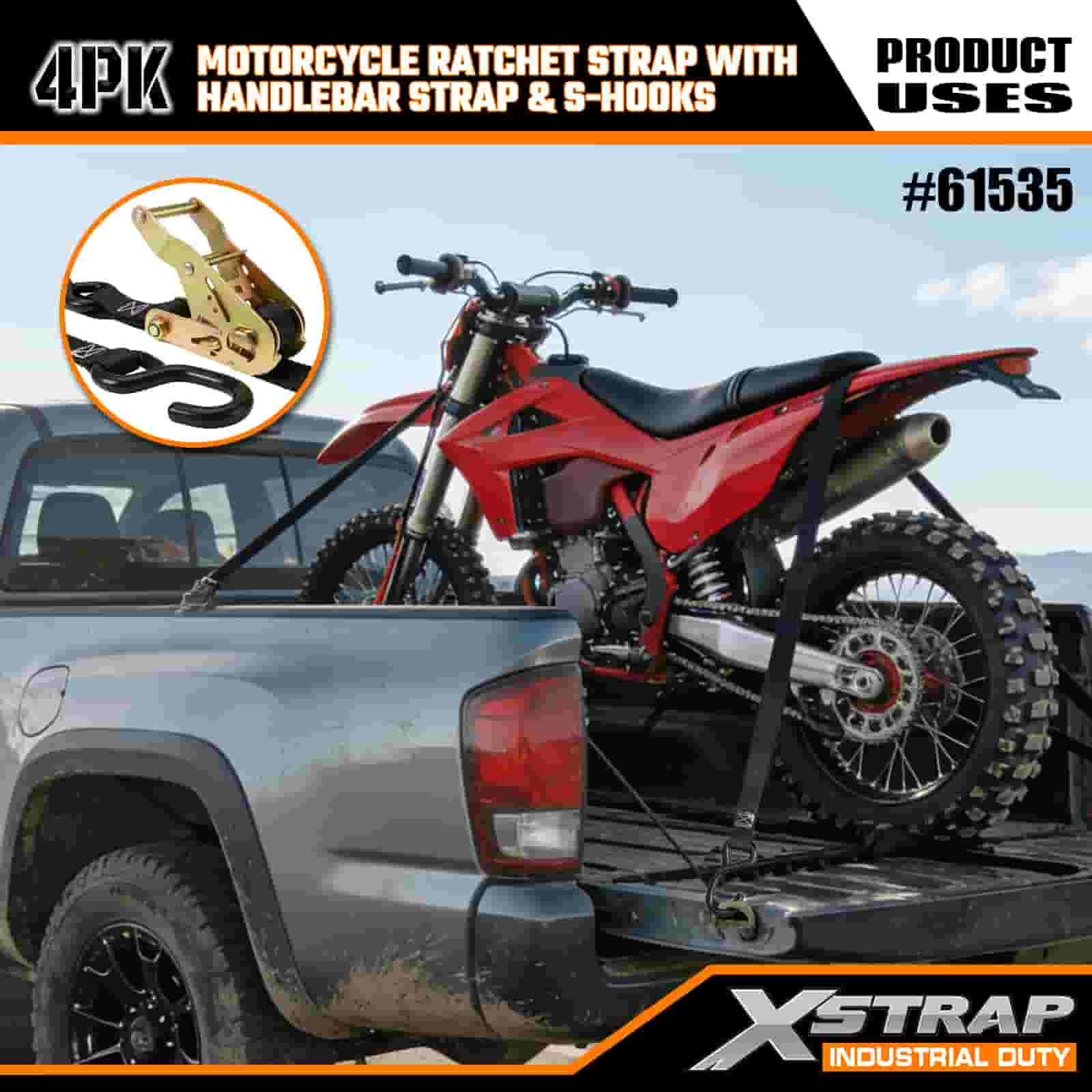 Custom Xstrap 61535 1” x 7’ 4PK Motorcycle Ratchet Strap with Handlebar Strap & Zhangjiagang SMK MFG. Co., Ltd is top China Xstrap 61535 1” x 7’ 4PK Motorcycle Ratchet Strap with Handlebar Strap & S Hooks 833lb SWL Su...View Product → often include integrated soft loops and shorter lengths to reduce excess webbing.
 - Car and Vehicle Hauling: Securing a vehicle by its wheels is safer than hooking to the body or axle. Wheel nets and over-the-tire straps prevent suspension movement and eliminate the risk of body-hook damage. If you are using axle straps, route them so they do not contact brake lines, sensors, or rubber boots.
Common Mistakes to Avoid When Using Ratchet Straps
Most cargo incidents trace back to a handful of preventable errors. Here are the ones we see most often in the field:
- Twisted Webbing: As noted, twists cut effective strength. Always run your hand along the strap to flatten it before tightening.
- Partially Seated Hooks: The hook must contact the anchor on its full bearing surface. A hook caught by its tip can straighten or let go.
- Over-Tightening: More tension does not equal more safety. Excessive force can damage the cargo directly or create a shock load scenario where the strap instantly fails if the load shifts.
- Using Damaged Equipment: A strap with a small cut or a hook with surface rust may still look "good enough." It is not. Once visible damage exists, the equipment's remaining strength is unknown.
- Wrong Anchor Points: Plastic bed caps, thin sheet metal brackets, or unrated loops are not anchor points. Use only factory-installed tie-down points or rated aftermarket hardware.
- Using Straps for Towing: Ratchet straps are designed to hold cargo down, not to pull vehicles. Towing straps stretch and store energy differently. The hardware on a ratchet strap can become a deadly projectile if used as a recovery strap. We examine this risk in detail when discussing whether regular ratchet straps are safe for towing.
How to Maintain and Store Your Ratchet Straps
Polyester webbing is tough, but it degrades predictably when neglected. After use, especially in muddy, salty, or chemically exposed environments, wipe the webbing down with a damp cloth and mild soap. Do not machine-wash straps, as the agitation can damage fibers and stitching. Let all components dry completely before coiling. Store straps in a dry, dark place. UV radiation breaks down polyester over time—a strap left in direct sunlight on a truck bed will lose strength faster than one kept in a tool box. Occasionally apply a thin silicone-based lubricant to the ratchet hinge points and gear teeth to prevent corrosion and binding. If the legible tag wears off, use a permanent marker to re-write the WLL on the ratchet body. More detailed material comparisons are available in our analysis of UV resistance and elastic recovery of tie-down webbing.
Choose the Right Ratchet Tie Down Straps for Your Needs
Strap selection starts with the weight you need to control, not the weight of your vehicle. The Working Load Limit (WLL) on the tag is the maximum load the strap can handle in a direct pull. In practice, you typically use multiple straps, and the total WLL of your tie-down system should at least match the cargo weight. Here is a general sizing reference:
| We Width | Typical WLL Range | Common Use |
|---|---|---|
| 1 inch | 400 – 500 lb | Light cargo, motorcycles, gear, pickup bed items |
| 2 inches | 1,000 – 3,300 lb | General utility, cars, construction materials, standard trailers |
| 3 inches | 5,000 – 5,400 lb | Heavy equipment, large flatbed loads |
| 4 inches | 10,000 lb and above | Oversized industrial cargo, heavy machinery |
For most users, 2-inch straps represent the sweet spot of handling ease and strength. A set of retractable ratchet tie-down straps (2-pack, 2" x 10')works well for frequent, varied loads. If you are just starting out with lighter loads, a complete 500 lb ratchet tie down straps (4-pack)provides a ready-to-use kit. For a broader decision framework that covers all strap types and attachment methods, see our full guide on how to choose the right utility tie-down straps.
 Custom Xstrap 61100 1” x 15’ 4PK Ratchet Tie Down 500lb SWL Suppliers, OEM/ODM FZhangjiagang SMK MFG. Co., Ltd is top China Xstrap 61100 1” x 15’ 4PK Ratchet Tie Down 500lb SWL Suppliers and OEM Factory, details:1. Pr...View Product →
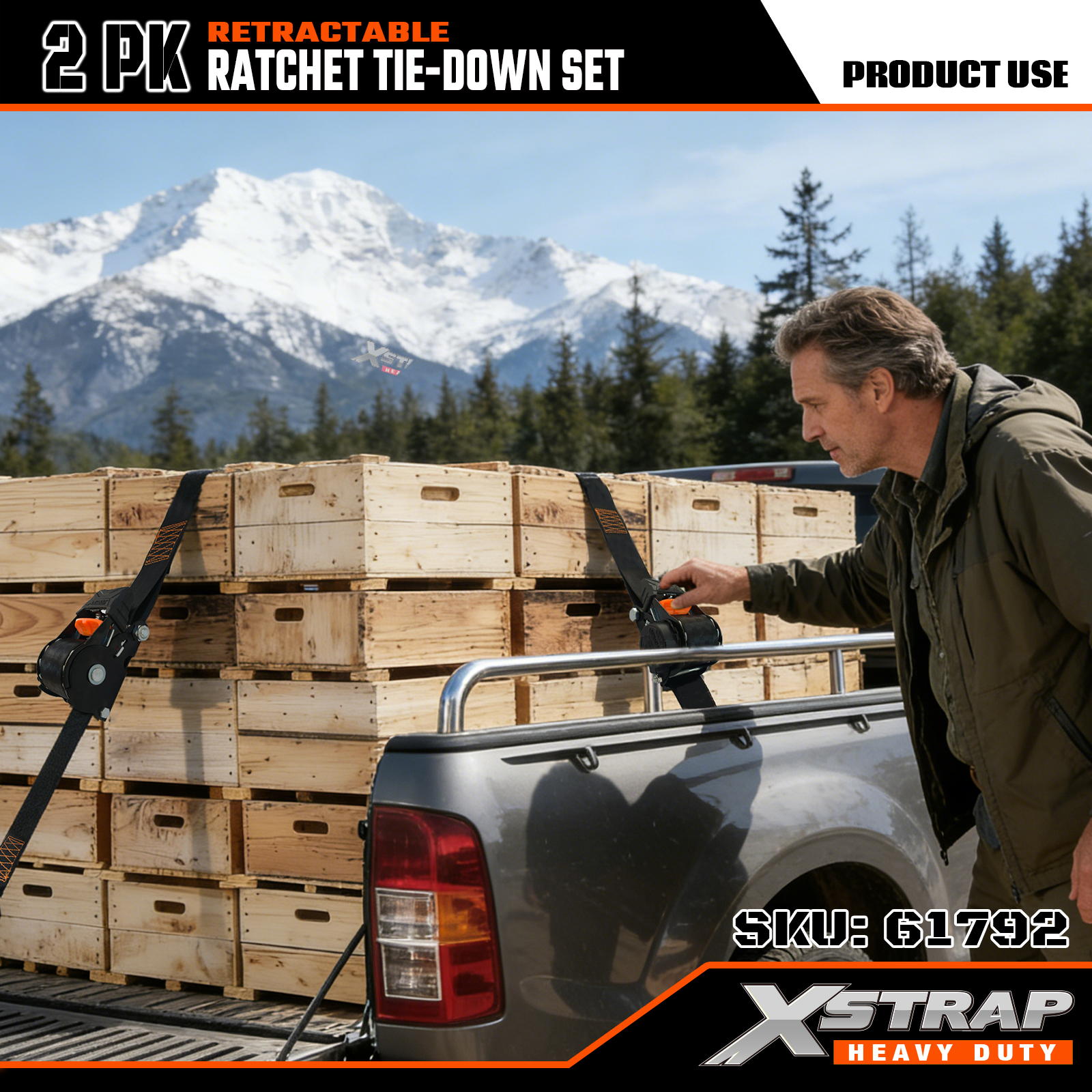 Custom Xstrap 61792 2PK 2” x 10’ Retractable Ratcet Tie Down Set with Safety S HZhangjiagang SMK MFG. Co., Ltd is top China Xstrap 61792 2PK 2” x 10’ Retractable Ratcet Tie Down Set with Safety S Hooks 1011lb SWL Supp...View Product →
Final Thoughts: Secure Your Cargo with Confidence
Correct ratchet strap use is a repeatable, learnable sequence: inspect, position, hook, thread, tighten, secure, and release. The difference between a load that stays put and a load that shifts is rarely the strap itself. It is the user's attention to flat webbing, fully seated hooks, matched anchors, and appropriate tension. Regular inspection and clean storage then keep that reliable equipment ready for the next job. As a manufacturer that builds these products daily, we see the engineering that goes into every stitch and ratchet tooth—and we know that the final responsibility for safety sits with the operator. Apply these steps consistently, and you will transport with far less risk and far more predictability.
Popular Products
Recent News
 How Do You Choose the Right Utility Tie Downs and Bungee Cords for Your Needs
Introduction
When it comes to securing your gear for transport, storage, or organization, Utility Tie Downs and Bungee Cords are essential tools. Whether you're hauling heavy loads...
 The Ultimate Guide to Ratchet Straps: Choosing, Using, and Maintaining Them
Introduction to Ratchet Straps
What Are Ratchet Straps?
Ratchet straps, also known as tie-down straps or cargo straps, are a type of load securement tool widely used in transportat...
 How Can Ratchet Tie Down Standard Duty Straps Ensure Safe and Reliable Cargo Securement
What Are Ratchet Tie Down Straps and Why Are They Important for Cargo Securement?
Introduction to Ratchet Tie Down Straps
Ratchet tie down straps are essential tools for anyone inv...
 What are Ratchet Straps and how do they help you transport your items safely
What Are Ratchet Straps?
Ratchet straps, also known as ratchet tie-downs or cargo straps, are heavy-duty fastening tools designed to secure items during transportation. They consis...
 How to Properly Use Light Duty Ratchet Tie Downs for Maximum Load Security
Understanding the Basics of Ratchet Tie Down Light Duty Straps
Ratchet tie-down straps are a critical tool in the transportation, storage, and securement of goods. They are used to...
-
 +86-18112697781qindan355@gmail.comNo. 21 Yuefeng Road, Yangshe Town, Zhangjiagang City, Suzhou City, Jiangsu Province
 -
Quick Links
Social Media
-
OEM Partner
-


Copyright © 2025 Zhangjiagang SMK MFG. Co., Ltd. All rights reserved.
 Wholesale Tension Strap Manufacturers
Wholesale Tension Strap Manufacturers