
 English
 Français
 Español

What Are Tie Down Straps and How Do You Use Them Safely
2026-04-10
Why Securing Your Load Matters More Than You Think
Every year, thousands of highway accidents are caused by one thing that could have been prevented in under ten minutes: unsecured cargo. A loose piece of lumber, a sliding ATV, a shifting refrigerator on a flatbed — these aren't just inconveniences. They're projectiles. And the driver who failed to properly rig their tie downs is legally, financially, and morally on the hook for what happens next.
Yet surprisingly, a lot of people still treat cargo securement as an afterthought. They grab whatever tie straps are sitting in the truck bed, loop them loosely over the load, and call it good. That approach works — right up until it doesn't.
The Real Cost of Getting It Wrong
Let's talk numbers for a second. In the US alone, road debris causes over 200,000 accidents annually, and a significant portion of those incidents trace back to improperly secured loads. The consequences stack up fast:
Legal fines: DOT violations for improper cargo securement can run from a few hundred to several thousand dollars per infraction.
Civil liability: If your load shifts and causes an accident, you can be held personally liable for property damage, injury, and in worst cases, wrongful death.
Equipment damage: A load that shifts mid-transit doesn't just endanger others — it can destroy the cargo itself, costing you far more than a proper set of tie down straps ever would.
License consequences: For commercial drivers, a cargo securement violation can go on your CDL record and affect your livelihood.
None of this is meant to scare you away from hauling. It's meant to reframe how seriously you take the ten minutes it takes to rig your tie downs correctly before every trip.
How Tie Downs Became a Safety Standard
Tie down straps, tie down hooks, and tie straps didn't always look the way they do today. Early cargo securement relied on rope, chain, and basic metal clips — tools that worked but required significant skill and time to use effectively. As highway freight grew through the mid-20th century, so did the need for faster, more reliable, and more standardized securement systems.
Ratchet mechanisms changed everything. By allowing a driver to apply precise, measurable tension to a tie down strap without specialized knot knowledge, ratchet tie downs democratized load securement. Suddenly, a one-person operation could safely rig a multi-point system in minutes. Tie down hooks evolved in parallel — from crude S-hooks to purpose-engineered J-hooks, flat hooks, and wire hooks designed to interface cleanly with truck beds, trailer rails, and D-ring anchor systems.
Today, tie straps and tie down hooks are manufactured to meet strict industry standards, with rated working load limits (WLL) printed directly on the webbing label. That little tag isn't decoration — it's a legal document telling you exactly how much tension your tie down can safely handle.
Who Actually Needs to Know This
The honest answer? Pretty much anyone who puts cargo on a vehicle that isn't enclosed.
Pickup truck owners hauling construction materials, furniture, or recreational gear.
Flatbed and semi-truck drivers managing commercial freight day in and day out.
Outdoor enthusiasts transporting motorcycles, ATVs, kayaks, and bikes.
DIY movers who rent a trailer once a year and figure they'll "wing it".
Small business owners running delivery routes with open-bed vehicles.
Whether you're using a single tie strap to hold down a lawnmower or running a full 4-point tie down system on a loaded flatbed, the principles are the same. The hardware — specifically the quality of your tie down hooks and the condition of your tie straps — determines whether your load arrives safely or becomes a highway hazard.
Understanding the Basics: What Are Tie Downs?
At its core, a tie down is any system used to restrain cargo during transport. But that simple definition covers a surprisingly wide range of hardware, techniques, and rated capacities. Before you can choose the right tie straps or tie down hooks for a job, it helps to understand what you're actually working with — and why each component exists.
The Three-Part System
Most people think of a tie down strap as a single piece of equipment. In practice, it's a system with three distinct parts working together:
1. The Webbing (Tie Strap)
This is the flat, woven polyester band that bears the actual load tension. Width typically ranges from 1 inch to 4 inches, and the weave density directly affects how much force the strap can handle before deforming or snapping. Polyester is the material of choice for most tie straps because it resists UV degradation, absorbs minimal water, and maintains consistent tension even in temperature extremes.
2. The Tensioning Mechanism
This is what converts a loosely draped strap into a taut, load-bearing system. Ratchets are the most common, using a pawl-and-gear mechanism to incrementally tighten the tie down strap with each handle stroke. Cam buckles use a simpler friction-based clamp. The mechanism you choose affects how much tension you can apply and how quickly you can rig or release the system.
3. The Tie Down Hooks
These are the metal end fittings that anchor the strap to a fixed point — a truck bed rail, a D-ring, a stake pocket, or a trailer floor loop. Tie down hooks take the full brunt of the load force at the anchor point, which is why hook quality matters as much as strap quality. A premium tie down strap attached to a cheap, thin hook is only as strong as that hook.
Common Materials Breakdown
| Component | Common Material | Why It's Used |
|---|---|---|
| Webbing | Polyester | UV resistant, low stretch, weatherproof |
| Ratchet body | Steel (zinc-plated) | High strength, corrosion resistance |
| Tie down hooks | Forged or stamped steel | Load-bearing capacity, durability |
| Hook coating | Zinc, powder coat, or vinyl dip | Prevents rust, protects cargo surface |
| Cam buckle | Aluminum or steel | Lightweight, quick release |
One thing worth noting: tie straps made from nylon exist, but nylon stretches significantly under load — sometimes up to 10% — which means your cargo can shift even when the strap feels tight. For most hauling applications, polyester webbing is the more reliable choice.
Breaking Strength vs. Working Load Limit — What the Numbers Mean
This is where a lot of people get tripped up, and getting it wrong can be genuinely dangerous.
Every tie down strap comes stamped or printed with two key figures:
Breaking Strength (BS)
This is the absolute maximum force the tie strap can withstand before it physically fails — tears, snaps, or the tie down hook pulls free. This number sounds impressive. A 2-inch ratchet strap might list a breaking strength of 10,000 lbs. But this is a laboratory figure, tested under ideal, controlled conditions with a brand-new strap pulled in a perfectly straight line. It is not the number you should be working from in the field.
Working Load Limit (WLL)
This is the number that actually governs safe use. WLL is typically set at one-third of the breaking strength — so that 10,000 lb breaking strength strap has a WLL of roughly 3,333 lbs. The gap between those two numbers exists to account for real-world variables: worn webbing, angled pulls, vibration, shock loading when a vehicle hits a bump at speed, and the cumulative fatigue that builds up across hundreds of uses.
| Breaking Strength | Working Load Limit (WLL) | Typical Strap Width |
|---|---|---|
| 3,000 lbs | 1,000 lbs | 1 inch |
| 6,000 lbs | 2,000 lbs | 1.5 inch |
| 10,000 lbs | 3,333 lbs | 2 inch |
| 20,000 lbs | 6,667 lbs | 3 inch |
| 30,000 lbs | 10,000 lbs | 4 inch |
The WLL of your tie down hooks must match or exceed the WLL of your tie straps. It does no good to run a 3,333 lb WLL strap through a hook rated for 1,500 lbs. The weakest point in the system sets the limit for the entire system — always.
A Word on Aggregate WLL
When you're using multiple tie downs on a single load, you don't just pick one strap's WLL and call it the capacity. You add them up — that's your aggregate WLL. DOT regulations require that the aggregate WLL of all tie down straps used on a load must equal at least 50% of the cargo's total weight. So a 4,000 lb load needs at least 2,000 lbs of aggregate WLL across all tie straps combined — at minimum. Most experienced haulers aim higher, treating that 50% figure as a floor, not a target.
Understanding these numbers before you ever touch a tie down hook is the difference between a rig that holds and one that lets go at 65 mph.
Types of Tie Down Straps: Choosing the Right One
Not all tie straps are built for the same job. Using the wrong type doesn't just make the work harder — it can mean your load isn't actually secure, even when everything looks fine from the outside. Here's how the main types break down.
Ratchet Tie Down Straps
The most widely used tie down system for serious hauling. A ratchet mechanism lets you crank the strap tight in controlled increments, which means you can apply consistent, measurable tension across the entire tie strap length.
Best for: heavy equipment, motorcycles, ATVs, furniture, construction materials — anything that needs to stay absolutely locked in place over a long haul.
The tradeoff: ratchets apply a lot of force. On soft or finished surfaces, that tension can dent, scratch, or compress the cargo if you're not using protective padding.
Cam Buckle Tie Straps
Cam buckles work on friction rather than mechanical advantage. You thread the webbing through, pull it snug, and the cam locks it in place. Simple, fast, and easy to release — but the tension ceiling is much lower than a ratchet system.
Best for: lighter loads under 500 lbs, fragile or finished surfaces, situations where you need to reposition cargo frequently.
Not ideal for: highway speeds, heavy loads, or anything that will shift under vibration.
Endless Loop / Flat Straps
These are simple loops of webbing with no hooks or buckles — just a continuous band of tie strap material. They wrap around a load or through anchor points and are used in combination with a separate ratchet or tensioner.
Best for: cargo with surfaces that would be damaged by tie down hooks — think polished alloy wheels, painted bodywork, or wrapped freight.
Side-by-Side Comparison
| Type | Max Tension | Release Speed | Best Load Type | Hook Required |
|---|---|---|---|---|
| Ratchet strap | High | Moderate | Heavy, long haul | Yes |
| Cam buckle strap | Low-Medium | Fast | Light, delicate | Yes |
| Endless loop | Varies | Fast | Fragile surfaces | No |
How to Match Strap Width and Length to Your Cargo
Width and length aren't just sizing details — they directly affect how your tie down straps perform under load.
Width guidance:
1 inch straps — light duty, bikes, small equipment under 500 lbs.
2 inch straps — the everyday standard, motorcycles, furniture, general freight.
3-4 inch straps — flatbed commercial loads, heavy machinery.
Length guidance:
A common mistake is buying tie straps that are too short. You want enough length to reach your anchor point at a favorable angle — ideally between 45 and 90 degrees to the load surface. Straps pulled at extreme angles lose effective tension and put uneven stress on the tie down hooks. For most pickup truck beds, 12-16 ft straps cover the majority of situations. Flatbed applications often call for 20-27 ft.
Tie Down Hooks: The Unsung Hero of Load Security
People spend a lot of time comparing tie straps and almost no time thinking about the hooks. That's backwards. Your tie down hooks are the only thing connecting the entire tension system to a fixed point on your vehicle. If a hook fails, the strap doesn't matter — the load is gone.
J-Hooks, Flat Hooks, and Wire Hooks
J-Hooks
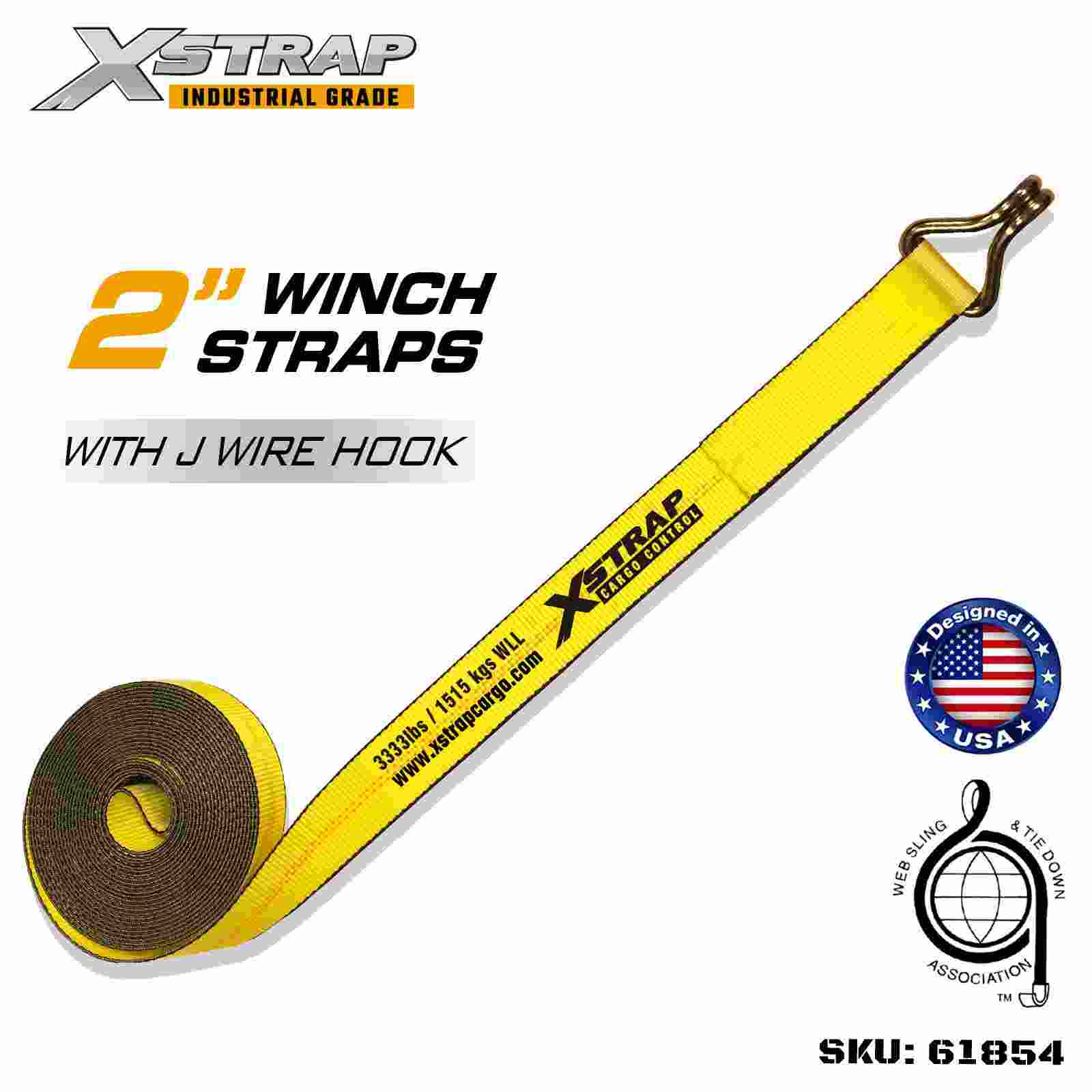
The most common tie down hook style. Named for their shape, J-hooks slip into stake pockets, trailer rails, and D-rings quickly and hold well under direct downward or lateral load. They're the default choice for most ratchet tie down straps sold today.
Flat Hooks (F-Hooks)
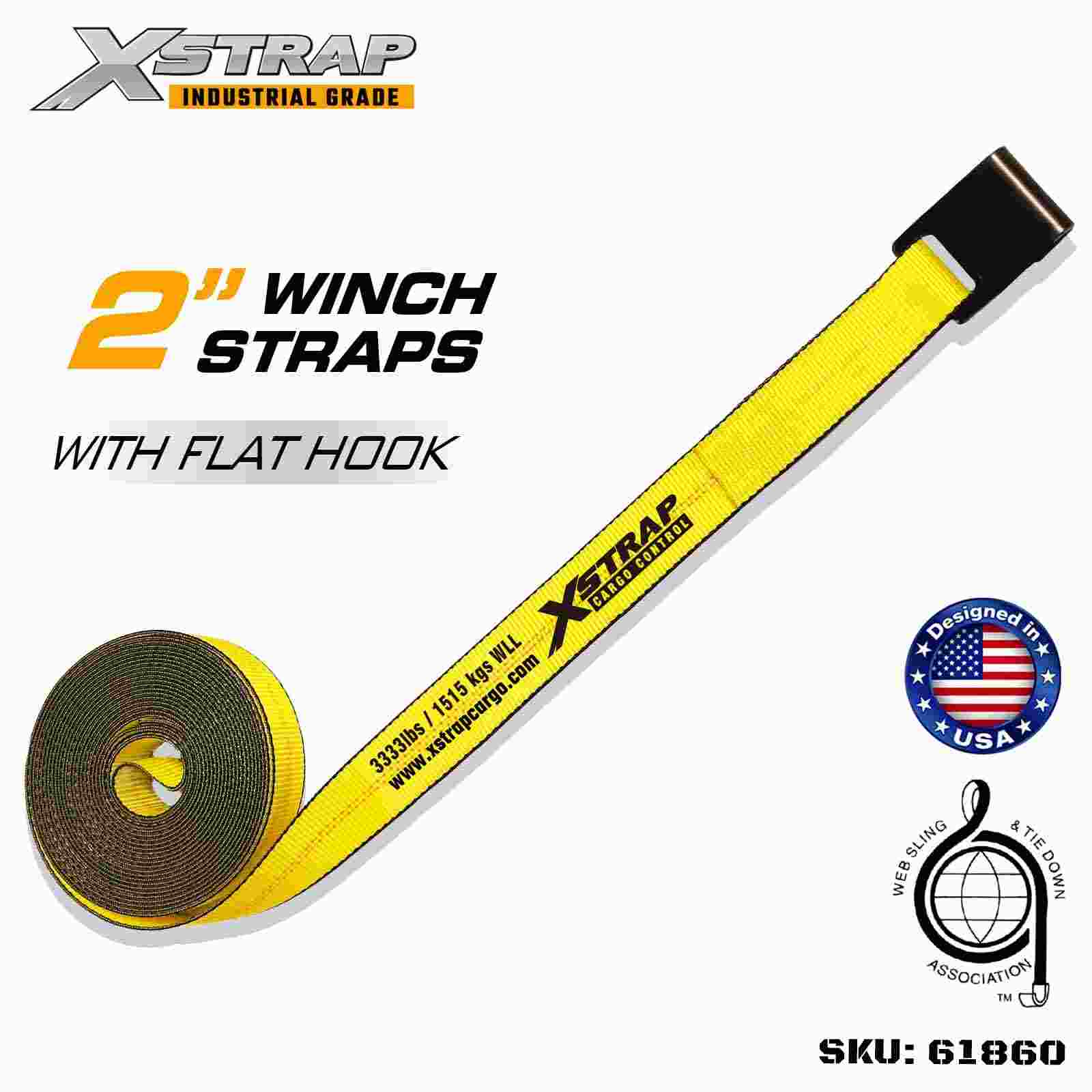
Wider and flatter than J-hooks, these tie down hooks sit flush against surfaces and are less likely to rotate or shift under load. Popular in flatbed trucking where anchor rails run along the deck edge. They offer a more stable connection point when the pull angle isn't perfectly vertical.
Wire Hooks
Lighter and more flexible than stamped steel hooks, wire hooks can reach into tighter anchor points that a standard tie down hook can't access. Common in automotive transport and enclosed trailer applications. Lower WLL ratings than forged hooks — not the right choice for heavy loads.
Hook Comparison at a Glance
| Hook Type | Typical WLL | Best Application | Anchor Compatibility |
|---|---|---|---|
| J-Hook | 1,000-10,000 lbs | General hauling, trailers | Stake pockets, D-rings, rails |
| Flat Hook | 3,000-15,000 lbs | Flatbed, rail systems | Deck rails, E-track |
| Wire Hook | 500-3,333 lbs | Auto transport, enclosed trailers | Tight or recessed anchors |
Material and Coating: Why It Matters
A tie down hook sitting in an open truck bed gets exposed to rain, road salt, UV, and temperature swings constantly. The base material and surface treatment determine how long it holds up.
Zinc-plated steel is the most common finish on mid-range tie down hooks — it resists surface rust reasonably well and holds up in normal weather conditions. Powder-coated hooks offer better long-term corrosion resistance and are less likely to scratch cargo surfaces on contact. Vinyl-dipped hooks add a soft outer layer that protects both the hook and whatever it's touching — common on hooks used for motorcycles and finished equipment.
Bare, uncoated steel hooks will rust faster than you'd expect, especially in coastal or high-humidity environments. Once corrosion starts working into the metal, the hook's actual load capacity becomes unpredictable.
Signs Your Tie Down Hooks Need Replacing
This is the part most people skip until something goes wrong. Before every haul, take fifteen seconds to look at your tie down hooks:
Visible rust or pitting on the hook body — surface discoloration is one thing, but deep rust means the metal integrity is compromised.
Deformation or spreading of the hook opening — a hook that's been overloaded will show a widened gap where it should be tight.
Cracks near the weld point where the hook meets the strap hardware — this is a stress fracture and means the hook is done.
Worn latch mechanism on safety-latch hooks — if the latch doesn't snap back firmly, the hook can walk free under vibration.
A set of tie down hooks that looks "mostly fine" is not fine if any of the above apply. The cost of replacing hooks is trivial compared to what a failed tie down costs you on the road.
How to Use Tie Down Straps and Hooks Correctly
Knowing which tie downs to buy is only half the job. How you rig them determines whether your load actually stays put. A high-quality tie down strap rigged badly is no safer than a cheap one — and in some cases, it's worse, because the false confidence leads to less checking along the way.
Step-by-Step: Rigging a Ratchet Tie Down Strap
Step 1 — Identify your anchor points
Before touching the tie strap, locate your anchor points on the vehicle. D-rings, stake pockets, and E-track rails are all valid. Make sure each anchor point is rated to handle the load you're placing on it. A tie down hook is only as secure as what it's clipped to.
Step 2 — Attach the hooks
Clip one tie down hook to the anchor point on the vehicle, then route the strap over or around the cargo. Attach the second tie down hook to the anchor point on the opposite side. Make sure both hooks are fully seated — no half-catches, no hooks resting on a lip instead of through a ring.
Step 3 — Feed and pre-tension the strap
Open the ratchet fully and thread the loose end of the tie strap through the mandrel slot. Pull the webbing through until there's minimal slack, then begin ratcheting. Take up slack gradually — don't try to get full tension in two strokes.
Step 4 — Apply working tension
Continue ratcheting until the tie down strap is firm and the cargo has no lateral or vertical movement. You shouldn't be able to lift the strap more than an inch off the cargo surface with two fingers. Don't over-crank — more on that below.
Step 5 — Lock and tuck
Close the ratchet latch to lock the mechanism. Tuck or bundle the excess tie strap webbing so it can't catch wind at speed and either flog itself to damage or create drag that gradually loosens the system.
The 4-Point Tie Down Method
For any load that has four corners — furniture, equipment, vehicles — the 4-point system is the standard approach. Each tie down strap runs from a corner of the load to an anchor point on the vehicle, creating a diamond-shaped tension pattern that resists movement in every direction simultaneously.
The logic is straightforward: two tie straps across the front resist forward shift during braking, two across the rear resist rearward shift during acceleration. Together, they also limit lateral movement side to side.
For this to work, all four tie down hooks need to be anchored at roughly equal distances from the load. An unbalanced 4-point rig — where two straps are short and tight and two are long and loose — creates uneven tension that can actually cause the load to rotate under stress.
Pulling Angles: Why They Matter
The angle at which a tie down strap runs from anchor point to cargo isn't just a geometry detail — it directly affects how much of the strap's rated capacity is actually working to hold the load down versus pulling it sideways.
A strap running at a steep angle (close to vertical) applies most of its tension as downward force — exactly what you want. A strap running nearly horizontal applies most of its tension as lateral force, which does little to prevent vertical bounce and can actually stress the cargo sideways.
| Strap Angle | Vertical Hold Force | Lateral Force | Recommended? |
|---|---|---|---|
| 90° (vertical) | 100% | 0% | Ideal but rarely achievable |
| 60° | 87% | 50% | Good |
| 45° | 71% | 71% | Acceptable minimum |
| 30° | 50% | 87% | Avoid if possible |
Aim to keep your tie down straps between 45 and 60 degrees from horizontal wherever the anchor points allow it.
Common Mistakes That Cause Tie Downs to Fail
Over-tightening
Ratchet tie down straps can generate enormous tension — far more than most people realize. Cranking a strap beyond its WLL doesn't make the load more secure. It stresses the webbing fibers, deforms the tie down hooks, and can crush or crack cargo that isn't designed to take that kind of compressive force.
Routing straps over sharp edges
A tie strap draped over a sharp metal corner is being cut, not tensioned. Use edge protectors — rubber guards or corner sleeves — anywhere the webbing contacts a hard edge.
Not checking mid-journey
Webbing settles. Cargo shifts slightly as it vibrates. A tie down strap that felt solid at the start of a two-hour drive may have lost meaningful tension by the halfway point. Stop and check — especially in the first 15-20 minutes after loading.
Crossing straps without purpose
Some people cross tie down straps diagonally thinking it adds security. It can — but only if the crossing is intentional and both hooks are properly anchored. Random crossing usually just creates uneven tension and makes it harder to spot which strap is actually doing the work.
Tie Down Ratings, Standards and Legal Requirements
Using tie downs isn't just a best practice — in most jurisdictions, it's the law. And the law is more specific than most people expect. It's not enough to throw a couple of tie straps over a load and call it secured. There are actual calculations involved, and ignorance of the rules isn't a defense when a DOT officer pulls you over.
DOT Cargo Securement Regulations
In the United States, cargo securement on public roads is governed by the Federal Motor Carrier Safety Administration (FMCSA) under 49 CFR Part 393. While these regulations are written primarily for commercial vehicles, the underlying principles apply to anyone hauling cargo on an open vehicle.
Forward resistance: The aggregate WLL of all tie down straps must be capable of resisting a force equal to 50% of the cargo weight in the forward direction — accounting for hard braking scenarios.
Lateral and rearward resistance: Tie downs must also resist 25% of cargo weight in lateral and rearward directions.
Vertical resistance: The system must prevent the load from bouncing or lifting, which is where proper tie down hook placement and strap angle become critical.
How Many Tie Down Straps Does Your Load Actually Need?
This is the question most people guess at. Here's the actual framework:
| Cargo Length | Minimum Tie Downs Required |
|---|---|
| Under 5 ft | 1 (if under 1,100 lbs) |
| 5-10 ft | 2 |
| 10-15 ft | 3 |
| 15-20 ft | 4 |
| Each additional 10 ft | +1 |
These are minimums. If your cargo is irregularly shaped, top-heavy, or prone to rolling, more tie straps are always the right call. A load that meets the minimum count but still moves when you push it isn't legally or practically secured.
Aggregate WLL: Running the Numbers
Here's a simple real-world example. You're hauling a 3,000 lb piece of equipment on a flatbed using four 2-inch ratchet tie down straps, each with a WLL of 3,333 lbs.
Aggregate WLL = 4 x 3,333 = 13,332 lbs
Required minimum = 50% of 3,000 lbs = 1,500 lbs forward resistance
You're well within compliance on paper. But if two of those tie down hooks are showing wear or the tie straps have visible fraying, that rated WLL no longer applies — and you're liable.
Edge Protectors: When They're Required
Any time a tie strap runs over a sharp edge — metal corners, rough wood, structural beams — an edge protector is required both legally and practically. Without one, the webbing is being abraded with every vibration, degrading its strength far faster than normal use would.
Edge protectors can be rubber sleeves, plastic corner guards, or even folded heavy cloth in a pinch. The point is to keep the tie down strap webbing in contact with a smooth surface along its entire run. If a DOT inspector sees webbing draped over bare metal edges without protection, that's a violation regardless of how new or strong the tie straps are.
A Note on Non-Commercial Haulers
If you drive a pickup truck and aren't operating commercially, federal DOT rules may not technically apply to you in every state. But most states have their own cargo securement statutes that mirror federal standards closely. More importantly, civil liability doesn't care about regulatory thresholds. If your load causes an accident, the question in court isn't whether you met the minimum strap count — it's whether you exercised reasonable care. Proper tie downs, properly rated tie down hooks, and correctly tensioned tie straps are your evidence that you did.
Popular Products
Recent News
 How Do You Choose the Right Utility Tie Downs and Bungee Cords for Your Needs
Introduction
When it comes to securing your gear for transport, storage, or organization, Utility Tie Downs and Bungee Cords are essential tools. Whether you're hauling heavy loads...
 The Ultimate Guide to Ratchet Straps: Choosing, Using, and Maintaining Them
Introduction to Ratchet Straps
What Are Ratchet Straps?
Ratchet straps, also known as tie-down straps or cargo straps, are a type of load securement tool widely used in transportat...
 How Can Ratchet Tie Down Standard Duty Straps Ensure Safe and Reliable Cargo Securement
What Are Ratchet Tie Down Straps and Why Are They Important for Cargo Securement?
Introduction to Ratchet Tie Down Straps
Ratchet tie down straps are essential tools for anyone inv...
 What are Ratchet Straps and how do they help you transport your items safely
What Are Ratchet Straps?
Ratchet straps, also known as ratchet tie-downs or cargo straps, are heavy-duty fastening tools designed to secure items during transportation. They consis...
 How to Properly Use Light Duty Ratchet Tie Downs for Maximum Load Security
Understanding the Basics of Ratchet Tie Down Light Duty Straps
Ratchet tie-down straps are a critical tool in the transportation, storage, and securement of goods. They are used to...
-
 +86-18112697781qindan355@gmail.comNo. 21 Yuefeng Road, Yangshe Town, Zhangjiagang City, Suzhou City, Jiangsu Province
 -
Quick Links
Social Media
-
OEM Partner
-


Copyright © 2025 Zhangjiagang SMK MFG. Co., Ltd. All rights reserved.
 Wholesale Tension Strap Manufacturers
Wholesale Tension Strap Manufacturers