
 English
 Français
 Español

Home / News / Industry News / The Complete Guide to Tie-Down Straps: Cam-Style vs. Ratchet-Style—Are You Really Choosing the Right One
The Complete Guide to Tie-Down Straps: Cam-Style vs. Ratchet-Style—Are You Really Choosing the Right One
2026-04-17
What Are Cam Straps and Why Do They Matter?
When you're hauling cargo — whether it's a kayak on the roof rack, furniture in a pickup bed, or equipment on a trailer — the last thing you want is for something to shift mid-drive. That's where cam tie down straps come in.
Cam buckle tie downs are a type of securing strap that uses a simple cam mechanism to grip the webbing and hold tension without any cranking or mechanical leverage. You thread the strap through the buckle, pull it tight by hand, and the internal cam teeth lock the webbing in place. Simple, fast, and effective for most everyday loads.
Unlike ratchet straps, cam tie down straps don't apply extreme tension — which is actually a feature, not a flaw. For loads that can be crushed, scratched, or distorted under high pressure (think bicycles, canoes, or padded furniture), cam straps offer a gentler but reliable hold.
They come in a wide range of sizes, hook styles, and load ratings. Some are lightweight and compact enough to toss in a backpack. Others are built as heavy tie down straps designed for serious hauling work. Understanding which type fits your situation is what this guide is all about.
Cam Buckle Tie Down Straps vs Ratchet Straps: Which One Do You Need?
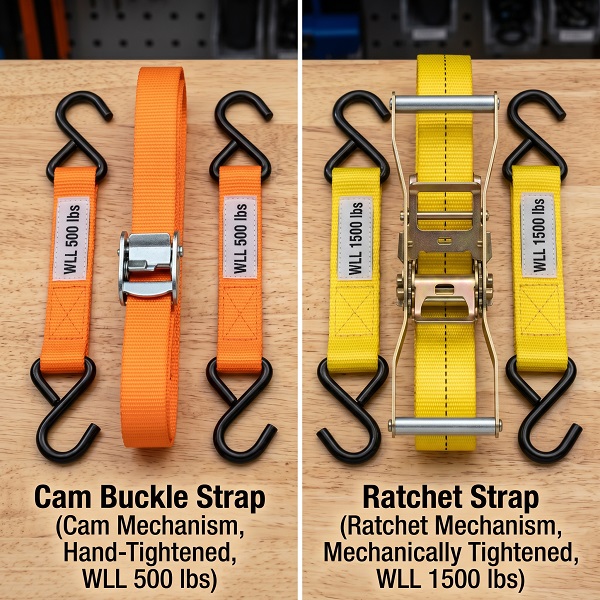
This is the question most people ask first — and the honest answer is: it depends on what you're moving and how far you're going.
Both cam buckle tie down straps and ratchet straps are designed to secure cargo, but they work differently and excel in different situations.
| Feature | Cam Buckle Tie Down Straps | Ratchet Tie Down Straps |
|---|---|---|
| Tensioning Method | Hand-pull only | Mechanical ratchet leverage |
| Max Tension | Low to moderate | High |
| Risk of Over-tightening | Low | Higher |
| Best For | Soft/delicate loads | Heavy or high-risk loads |
| Ease of Use | Very easy | Moderate |
| Release Speed | Instant | Requires ratchet reversal |
| Typical WLL | 500–1,000 lbs | 1,500–5,000+ lbs |
| Bulk and Weight | Light and compact | Heavier, bulkier |
When to choose cam tie downs: Kayaks, canoes, bikes, motorcycles with sensitive paint, luggage, lightweight furniture, camping gear. Anywhere the load is manageable by hand tension and you don't want to risk crushing or marking the surface.
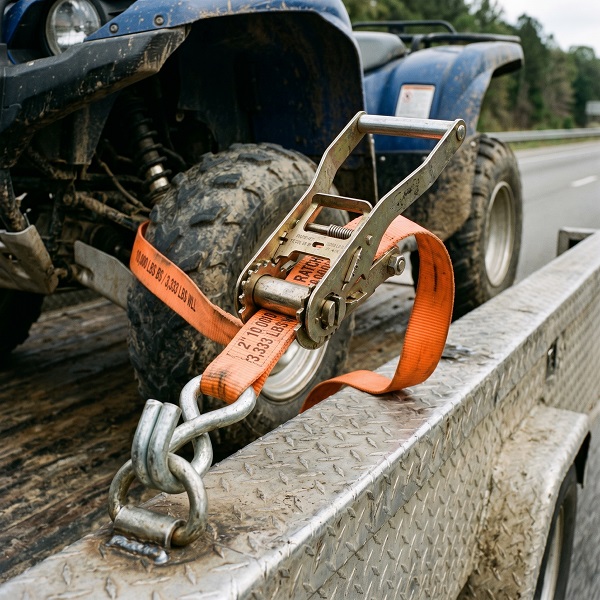
When to go with ratchet straps: ATVs, large appliances, construction equipment, flatbed loads, anything being transported at highway speeds over long distances. These are the situations that call for a heavy duty tie down strap with serious holding power.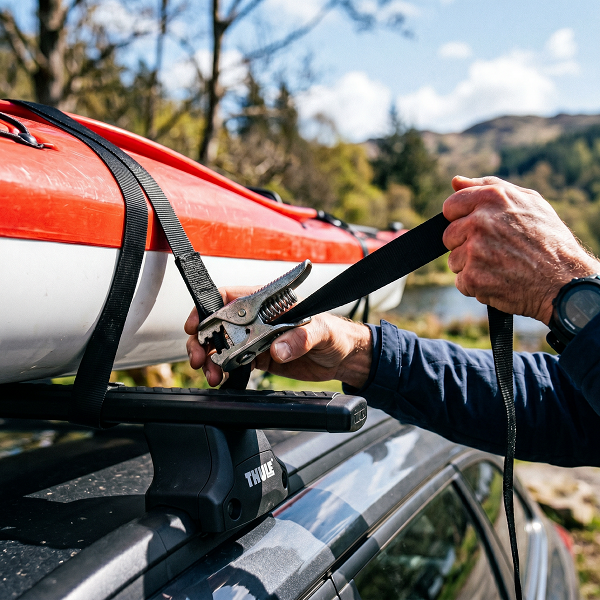
The cam strap vs ratchet strap debate doesn't really have a winner — it has a context. Most people who haul regularly end up keeping both on hand.
Types of Cam Lock Straps and Their Features
Not all cam straps are built the same. Once you start shopping, you'll notice several distinct types — and the differences actually matter.
Cam lock straps with hooks
These are the most common style. A J-hook or flat hook on each end clips into anchor points on your truck bed, trailer rails, or roof rack. Cam lock straps with hooks are the go-to for securing vehicles, large equipment, and anything with a solid anchor point to attach to. The hooks are usually coated or padded to reduce scratching.
Cam lock lashing straps (no hooks)
These use loops or bare webbing ends instead of metal hooks. A cam lock lashing strap is ideal when you're working with foam padding, rack systems, or loads where a metal hook could cause damage. Common with roof rack setups for surfboards, ladders, and canoes.
Cam buckle tie down straps (standard)
The classic flat-webbing design with a simple cam buckle. No locking mechanism beyond the cam teeth themselves. These are reliable for light to mid-range loads and are the most affordable option in the cam tie down category.
Material and load rating breakdown:
| Type | Typical Webbing Width | WLL Range | Best Application |
|---|---|---|---|
| Standard cam buckle | 1 inch | 300–500 lbs | Bikes, gear, luggage |
| Mid-grade cam lock | 1.5 inch | 500–1,000 lbs | Motorcycles, kayaks |
| Heavy tie down straps | 2 inch | 1,000–1,500 lbs | Equipment, large loads |
One thing worth noting: "cam lock" and "cam buckle" are often used interchangeably in product listings, but technically, cam lock tie down straps have an additional locking tab or safety mechanism that prevents accidental release. If you're securing anything valuable or heavy, that extra lock is worth having.
Heavy Duty Tie Down Straps: When You Need Maximum Holding Power
There's a point where a standard cam strap just isn't the right tool. If you're loading a riding mower, a small tractor, a loaded utility trailer, or industrial equipment, you need heavy duty tie down straps that are rated for the job.
What makes a strap "heavy duty"?
It comes down to three things: webbing width, breaking strength, and hardware quality. A proper heavy duty tie down strap will be clearly labeled with its Working Load Limit (WLL) — this is the maximum load it's designed to handle under normal use. The breaking strength is typically 3x the WLL, but you should never rely on that margin intentionally.
Common heavy-duty scenarios and strap recommendations:
| Load Type | Recommended Setup | Min WLL Per Strap |
|---|---|---|
| Motorcycle | 4 x cam lock straps with hooks | 500 lbs |
| ATV / UTV | 4 x ratchet straps | 1,500 lbs |
| Riding mower | 3 ratchet tie down straps + 1 safety | 2,000 lbs |
| Large appliances | 2 x heavy tie down straps | 1,000 lbs |
| Flatbed equipment | 4–6 x ratchet straps | 3,000+ lbs |
A common real-world setup is 3 ratchet tie down straps for mid-size loads like a small utility trailer with equipment — two straps crossing diagonally and one straight across the front. It's a reliable configuration, though for anything over 2,000 lbs total, four straps is the safer standard.
When buying heavy duty tie down straps, check for:
- WLL label clearly printed on the strap or tag
- DOT or WSTDA compliance markings
- Forged or stamped steel hooks (not cast)
- Webbing with no fraying or discoloration out of the box
How to Use Cam Buckle Tie Downs Correctly
Knowing which strap to buy is only half the job. Using cam buckle tie downs incorrectly is one of the most common reasons cargo shifts or falls — and it's almost always avoidable.
Step-by-step: threading and securing a cam buckle tie down strap
Step 1 — Anchor one end first
Clip the hook end to a fixed anchor point — a truck bed rail, trailer ring, or roof rack bar. Make sure the hook is fully seated and not just resting on the edge of a slot.
Step 2 — Route the strap over or around the load
Lay the webbing flat across the cargo. Avoid running it over sharp edges or corners directly — use padding (an old towel works fine) between the strap and any edge that could cut or fray the webbing over time.
Step 3 — Thread the free end through the cam buckle
Feed the webbing up through the bottom of the buckle opening. You'll feel the cam teeth engage as the strap passes through.
Step 4 — Pull to tension
Hold the buckle steady and pull the free end of the webbing firmly. The cam teeth will grip the strap and hold the tension as you pull. For cam tie down straps, hand tension is all you get — and for most loads, that's exactly enough.
Step 5 — Check and secure the tail
Once tensioned, tuck or wrap the loose webbing tail so it doesn't flap in the wind or catch on anything. Some cam straps come with a velcro wrap for this purpose.
Common mistakes that cause problems
- Crossing the strap at a bad angle — always aim for roughly 45 degree diagonal contact with the load where possible. Straight vertical straps can allow forward/backward shift.
- Running webbing over sharp metal — this can cut through the fibers under vibration. Always pad contact points.
- Assuming one strap is enough — even light loads benefit from two cam tie downs working in opposition. One forward-angled, one rearward-angled is a basic but solid approach.
- Not checking after the first few miles — webbing can settle and lose a small amount of tension. A quick check after your first stop is good habit.
Strap placement by load type
| Load | Number of Straps | Recommended Pattern |
|---|---|---|
| Kayak / canoe | 2 | One fore, one aft — looped under hull |
| Bicycle | 2 | Frame contact points, never wheels alone |
| Motorcycle | 4 | Two front forks, two rear subframe points |
| Furniture (boxed) | 2–3 | Cross-strap over top, one horizontal mid-body |
| Lumber / long goods | 3 | Front, mid, rear — all tied to side rails |
One thing that catches people off guard with cam buckle tie down straps: they're not designed to be overtightened. If you feel like you need more tension than you can get by hand, that's the load telling you to switch to a ratchet strap. Forcing a cam buckle beyond its design range doesn't make the load safer — it just stresses the webbing and hardware unnecessarily.
How to Store Ratchet Tie Down Straps and Cam Straps Properly
Good straps aren't cheap, and even the ones that are cheap become unreliable when they're stored badly. Learning how to store tie down straps properly is one of those small habits that pays off every time you go to use them.
Why storage matters more than people think
UV exposure degrades polyester webbing over time — the fibers weaken and the strap loses rated strength without showing obvious visible damage. Moisture leads to mildew and corrosion on the metal hardware. And tangled, kinked straps are not just annoying — a kink in the webbing creates a stress point that can fail under load.
How to coil and store cam tie down straps step by step
Step 1 — Release all tension and lay flat
Before storing, make sure the cam buckle is fully open and the webbing is no longer under any tension.
Step 2 — Fold or coil the webbing neatly
Don't just stuff it in a bag. Fold the webbing in even loops — roughly 12-inch lengths work well — keeping it flat rather than twisted. For longer cam straps, a loose figure-8 coil prevents kinking better than a tight circular coil.
Step 3 — Secure the coil
Wrap the last foot of webbing around the coil and tuck it through itself, or use a velcro strap wrap. This keeps everything from unraveling in storage.
Step 4 — Store hooks so they don't catch
Clip the hooks together or tuck them into the coil so they don't snag on other straps or tools in the same bag.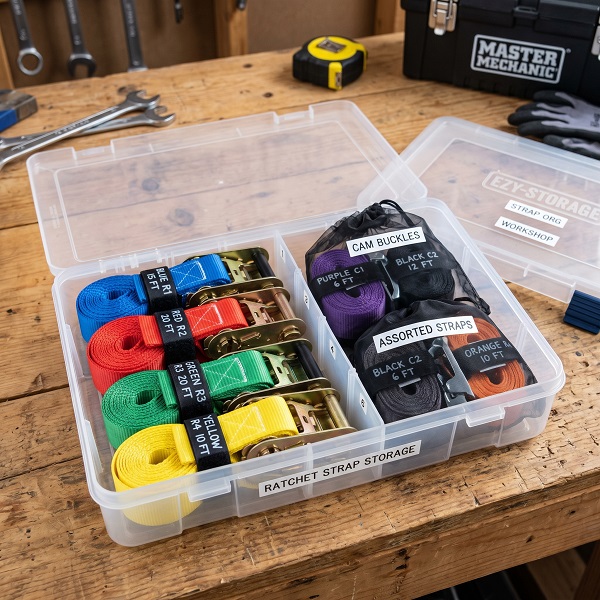
Storage environment checklist
| Condition | Recommendation |
|---|---|
| Light exposure | Store away from direct sunlight — UV damages webbing |
| Moisture | Keep dry; never store damp straps in a sealed bag |
| Temperature | Avoid prolonged heat exposure (e.g. sealed truck bed in summer) |
| Chemical contact | Keep away from fuel, oil, solvents — these degrade fibers |
| Sharp objects | Store separately from tools with edges that can snag webbing |
Best storage options
- Hanging hooks or pegboard — ideal for a garage setup; keeps straps visible and untangled
- Zippered mesh bags — good for in-vehicle storage, allows airflow
- Plastic bins with dividers — practical for multiple strap sets organized by length or rating
- Velcro strap wraps — the simplest solution; wraps around each coiled strap to keep it neat
Inspection before each use — what to look for
How to store ratchet tie down straps properly also means knowing when to retire them. Before each use, run the webbing through your fingers and check for:
- Fraying or cuts along any section of the webbing
- Fading or stiffness — signs of UV or chemical degradation
- Bent or cracked hooks — especially at the throat of the hook where stress concentrates
- Cam teeth that slip — if the buckle doesn't grip consistently, the strap is no longer trustworthy
- Mildew smell or discoloration — indicates moisture damage to the fibers
A strap that fails any of these checks should be replaced, not used "one more time." The cost of a new cam lock tie down strap is always less than the cost of a damaged load — or worse.
As a general rule, even well-maintained straps used regularly should be replaced every 2–3 years. Heavy-use straps or those stored in harsh conditions (outdoor trailers, work trucks) warrant annual inspection and more frequent replacement.
FAQ:
Q1: What's the real difference between cam buckle tie down straps and cam lock tie down straps?
They look similar and are often listed under the same category, but there's a functional difference. A standard cam buckle tie down uses a spring-loaded cam that grips the webbing when tension is applied — release the cam, and the strap feeds freely. A cam lock lashing strap adds a secondary locking tab or lever that physically blocks the cam from releasing accidentally. For everyday use, a standard cam buckle tie down strap is fine. For high-vibration environments — trailers, flatbeds, off-road hauling — the cam lock version gives you an extra layer of security worth having.
Q2: How do I know if my cam straps are strong enough for my load?
Check the WLL (Working Load Limit) printed on the strap tag or woven into the webbing label. This is the maximum load the strap is rated to handle under normal conditions. As a basic rule:
| Load Weight | Minimum Setup |
|---|---|
| Under 100 lbs | 1–2 x standard cam buckle straps (500 lb WLL each) |
| 100–500 lbs | 2–3 x mid-grade cam tie down straps |
| 500–1,500 lbs | 3–4 x heavy tie down straps or ratchet straps |
| 1,500 lbs+ | Ratchet straps only — check WLL per strap carefully |
Never add up the WLL of multiple straps and assume that equals your total safe load rating without factoring in strap angle. A strap pulling at a steep angle transfers less effective force than one running more horizontally across the load.
Q3: Can I use cam tie down straps in the rain or wet conditions?
Yes — polyester webbing, which is what most cam straps and cam lock lashing straps are made from, handles moisture reasonably well. It doesn't absorb water the way nylon does, so it maintains most of its strength when wet. That said, there are things to watch:
- Metal hooks can rust over time if repeatedly exposed to water and not dried out
- Always store straps dry — sealing damp straps in a bag accelerates mildew and corrosion
- Inspect hardware after heavy rain use; cam lock straps with hooks that show rust at the throat or tip should be retired
If you're regularly using cam tie downs in wet or marine environments, look for straps with stainless steel or zinc-coated hardware.
Q4: Are 3 ratchet tie down straps enough to secure a motorcycle?
For most standard motorcycles on a trailer, three straps can work — but four is the correct and safer answer. The standard method uses two straps on the front forks (pulling forward and outward at opposing angles to compress the suspension) and two on the rear subframe or swingarm. This creates a four-point hold that prevents the bike from rocking forward, backward, or side to side.
Using only 3 ratchet tie down straps leaves one corner of the bike with less control, which matters on longer trips or uneven roads. If you're doing a short local move on smooth roads, three may be acceptable — but it shouldn't become a habit.
Q5: Cam straps vs ratchet straps — which is safer for highway driving?
Neither is inherently unsafe if used correctly and rated for the load. The distinction comes down to load type and distance:
| Factor | Cam Straps | Ratchet Straps |
|---|---|---|
| Highway vibration resistance | Moderate | High |
| Risk of over-tensioning load | Low | Higher if overtightened |
| Best distance range | Short to medium hauls | All distances |
| Re-check frequency needed | Every stop recommended | Every stop recommended |
| Suitable for delicate loads | Yes | Use with caution |
For highway speeds over long distances with heavy loads, ratchet straps are the more reliable choice. Cam tie down straps are better suited to shorter trips or loads that can't handle high clamping force.
Q6: How long do cam buckle tie down straps typically last?
It depends heavily on how they're used and stored. A cam strap used occasionally and stored properly in a dry, dark environment can last 4–5 years or longer. One that lives in the back of a work truck, gets rained on regularly, and is never properly coiled might need replacing within a season.
| Usage Level | Expected Lifespan |
|---|---|
| Occasional (few times a year) | 4–6 years |
| Regular (weekly use) | 2–3 years |
| Heavy / commercial use | 1–2 years or less |
| Stored improperly (UV, moisture) | Replace regardless of age |
The webbing will often degrade before the hardware fails — so don't judge a strap's condition by its buckle alone. If the webbing feels brittle, looks faded, or has any visible cuts or worn spots, it's done regardless of how solid the cam buckle still feels.
Q7: What does WLL mean, and why does it matter more than breaking strength?
WLL stands for Working Load Limit — it's the maximum load a strap is designed and rated to carry under normal working conditions. Breaking strength is the point at which the strap will actually fail, and it's typically 3x the WLL.
The reason WLL matters more in practice: breaking strength is a laboratory number measured under controlled, static conditions. Real-world loads are dynamic — they shift, bounce, and surge. Always size your straps to the WLL, not the breaking strength. If your load is 800 lbs, you want straps with a combined WLL that comfortably exceeds that — not straps where 800 lbs is pushing toward the breaking point.
Q8: Can cam lock straps with hooks damage my vehicle or cargo?
They can, if used carelessly. The most common issues are:
- Hook contact scratching painted surfaces or soft materials — use rubber hook protectors or wrap the hook tip in cloth tape
- Webbing edge marking on soft cargo like kayaks or foam-wrapped items — slide a piece of cardboard or foam under the strap where it contacts the load
- Over-tensioning soft goods — cam buckle tie down straps are generally safe for soft cargo because hand tension has a natural limit, but check that the strap isn't cutting into anything
With a little padding and attention to where straps make contact, damage is easy to prevent. The hook is rarely the problem — it's usually about where and how the webbing sits on the load.
Popular Products
Recent News
 How Do You Choose the Right Utility Tie Downs and Bungee Cords for Your Needs
Introduction
When it comes to securing your gear for transport, storage, or organization, Utility Tie Downs and Bungee Cords are essential tools. Whether you're hauling heavy loads...
 The Ultimate Guide to Ratchet Straps: Choosing, Using, and Maintaining Them
Introduction to Ratchet Straps
What Are Ratchet Straps?
Ratchet straps, also known as tie-down straps or cargo straps, are a type of load securement tool widely used in transportat...
 How Can Ratchet Tie Down Standard Duty Straps Ensure Safe and Reliable Cargo Securement
What Are Ratchet Tie Down Straps and Why Are They Important for Cargo Securement?
Introduction to Ratchet Tie Down Straps
Ratchet tie down straps are essential tools for anyone inv...
 What are Ratchet Straps and how do they help you transport your items safely
What Are Ratchet Straps?
Ratchet straps, also known as ratchet tie-downs or cargo straps, are heavy-duty fastening tools designed to secure items during transportation. They consis...
 How to Properly Use Light Duty Ratchet Tie Downs for Maximum Load Security
Understanding the Basics of Ratchet Tie Down Light Duty Straps
Ratchet tie-down straps are a critical tool in the transportation, storage, and securement of goods. They are used to...
-
 +86-18112697781qindan355@gmail.comNo. 21 Yuefeng Road, Yangshe Town, Zhangjiagang City, Suzhou City, Jiangsu Province
 -
Quick Links
Social Media
-
OEM Partner
-


Copyright © 2025 Zhangjiagang SMK MFG. Co., Ltd. All rights reserved.
 Wholesale Tension Strap Manufacturers
Wholesale Tension Strap Manufacturers