
 English
 Français
 Español

Home / News / Industry News / How Tight Should a Ratchet Strap Be? Tension Guide for Safe Cargo Securement
How Tight Should a Ratchet Strap Be? Tension Guide for Safe Cargo Securement
2026-11-20
A ratchet strap should be tight enough to remove all slack and stop the load from shifting, but not so tight that the strap, ratchet, hooks, or cargo begin to distort. For most flatbed, trailer, and van loads, that means firm hand tension followed by two to four ratchet clicks, then a re-check after the first few miles.
Key takeaway: tension is a control variable, not a strength contest. A loose strap allows movement; an over-tightened strap can crush cargo, deform hardware, and reduce the strap's ability to absorb dynamic loads.
The Short Answer: Firm Tension, Not Maximum Force
A ratchet strap is tight enough when the webbing is flat, the load cannot be moved by hand, and the ratchet handle closes with firm resistance instead of extreme force. You should not need a cheater bar, and you should not see the cargo, the hook, or the ratchet buckle deforming. If the strap is humming under tension or the cargo has started to compress, back off one or two clicks.
The right tension changes with strap width and cargo type. A 1-inch light-duty strap for luggage, a small ATV, or a tent frame may need only enough tension to stop bouncing. A 2-inch strap on a flatbed carrying palletized freight usually needs more tension, but the target is still a stable load, not a crushed pallet. A 3-inch or 4-inch strap on heavy equipment or steel coils may need a higher tension force, yet the working load limit and the cargo's own strength set the ceiling.
- Correct tension: webbing lies flat, hooks sit square on the anchor point, and the load does not shift when you push it by hand.
- Too loose: the strap can be lifted off the load, the ratchet handle moves freely, or the cargo rocks when the vehicle is rocked.
- Too tight: the strap is digging into the cargo, the hook is pulling sideways, the ratchet handle is hard to close, or the webbing has started to wrinkle near the buckle.
Why Over-Tightening Is as Risky as Under-Tightening
Over-tightening feels safe because the load looks locked down, but it creates a different set of problems. Webbing is designed to stretch slightly under load; when it is stretched close to its limit before the vehicle moves, it has less capacity to absorb road vibration and dynamic peaks. That can transfer stress into the hooks, the ratchet, and the anchor points. In a hard brake or a pothole, the strap may not have enough reserve to handle the surge.
Cargo damage is the other issue. Palletized goods, appliances, vehicles, and fabricated parts can be dented or misaligned by a strap that is tightened like a winch line. The strap may also crush a soft cargo edge and then lose tension when the cargo relaxes. On a long run, that creates a re-tightening cycle: tight, crushed, loose, tight again.
Under-tightening is just as real. A strap with slack can slide off a rounded corner, vibrate against a sharp edge, or let the load walk sideways. The ratchet may look closed, but the webbing is not doing its job. The practical answer is to tighten until the slack is gone, add two to four clicks, and then check the load after the first 10 to 15 miles.
Tension by Cargo Type: A Practical Reference
Use the table below as a starting point, not a substitute for the strap label or the vehicle manufacturer's securement rules. The working load limit, the anchor point rating, and the cargo's own strength always control the final decision.
| Cargo type | Tension target | What to check | Common strap width |
|---|---|---|---|
| Palletized freight | Firm, no slack; two to three clicks after hand tension | Pallet integrity, strap contact points, load shift | 2 in |
| Lumber, pipe, and long stock | Firm and even across the bundle; avoid crushing the top layer | Bundle alignment, edge protection, front and rear restraint | 2 in or 3 in |
| Heavy equipment and steel coils | High tension within the strap's working load limit; use a controlled pull | Anchor rating, hook seating, coil chocks, strap protection | 3 in or 4 in |
| Vehicles on trailers | Firm wheel or chassis restraint; avoid pulling the body out of alignment | Wheel net or strap placement, suspension movement, re-check | 2 in |
| Boxed goods in vans | Light to moderate tension; stop movement without crushing cartons | Load bars, E-track contact, carton stacking pattern | 1 in or 2 in |
How to Judge Tension Without a Gauge
Most drivers do not carry a tension gauge, so the judgment has to come from the strap and the load. A simple sequence works better than guessing by sound or feel alone.
- Pull the webbing by hand first. Remove the slack until the strap lies flat against the cargo. Do not start ratcheting while the webbing is twisted or routed over a sharp edge.
- Close the ratchet with controlled strokes. Two to four clicks after hand tension is a useful range for many loads. Stop when the handle becomes noticeably harder to close.
- Push the load. If the cargo moves, the strap is not doing its job. If the cargo is visibly denting, the strap is too tight.
- Check the hardware. Hooks should be seated, not pulled sideways. The ratchet should be closed and the webbing should not be pinched against itself.
- Re-check after 10 to 15 miles. Loads settle, webbing relaxes, and vibration can change tension. A quick stop is the cheapest safety check you can make.
Hook choice also changes how tension is applied. A flat hook, wire hook, or chain anchor can sit differently on the anchor point, and that affects whether the strap pulls straight or twists. The guide to hook styles and cargo securement explains the trade-offs.
For 2-inch flatbed work, a wide-handle ratchet gives more leverage and better control than a short handle, which helps you stop at firm tension instead of over-cranking.
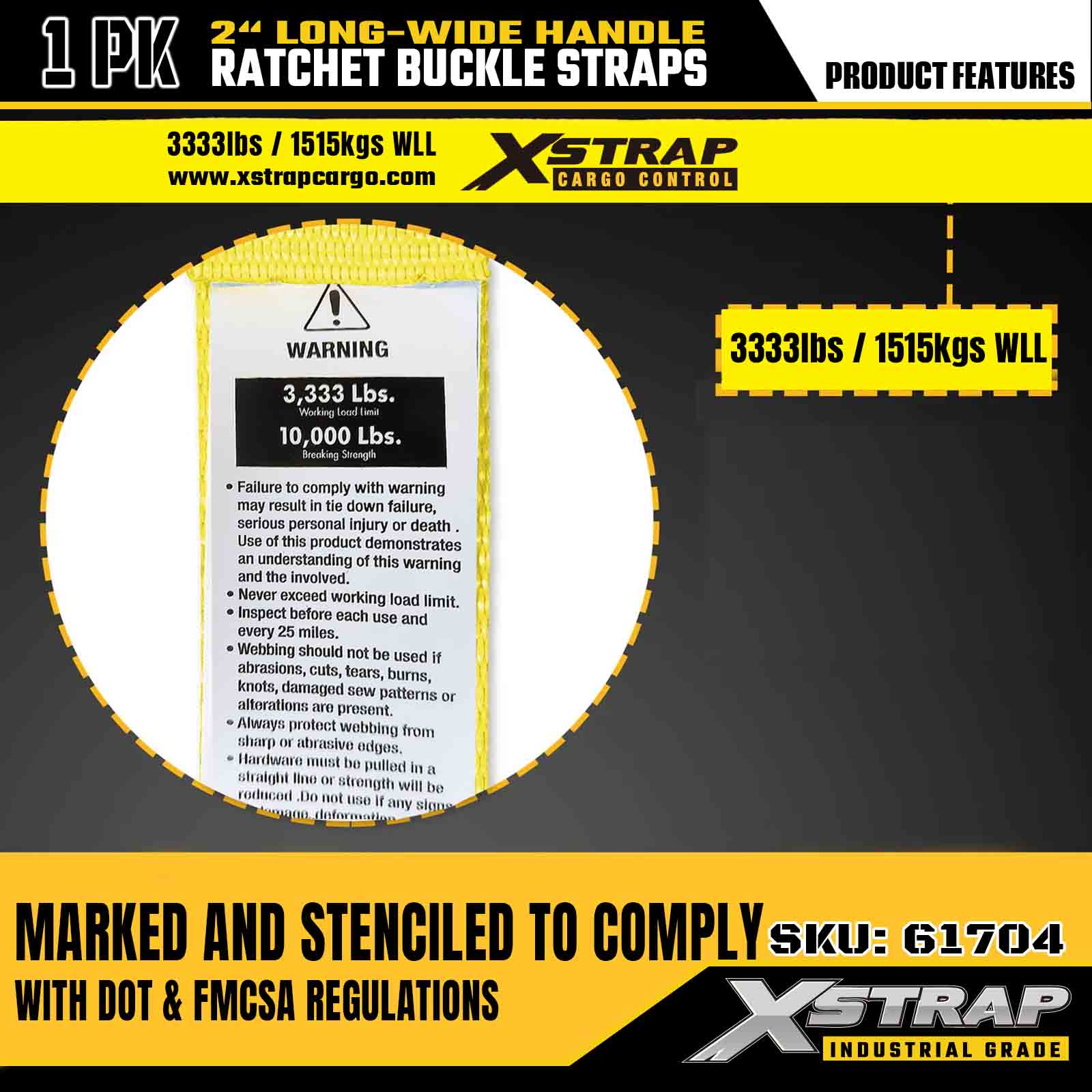 Xstrap 61704 2-Inch Heavy-Duty Ratchet Strap with Chain HooksFor 2-inch flatbed loads, this 30-foot strap pairs a long wide ratchet handle with reinforced chain hooks to help control tension.View Product →
Ratchet Strap Tension Checklist for Flatbed, Van and Trailer Loads
Use this checklist before the vehicle moves and again at the first safe stopping point. It keeps the focus on stability rather than brute force.
Flatbed loads
Route straps over the strongest part of the load, protect sharp edges, and tighten until the load cannot rock. Check that the strap is not pulling a stack out of alignment.
Van interior
Use E-track or logistic track to keep the strap line straight. Tighten enough to stop cartons from sliding, but stop before the strap crushes the carton corners.
Trailer and tow
Confirm the hook is seated on a rated anchor. A strap that is tight but hooked to a thin sheet-metal edge is still a weak point.
Re-check routine
After the first few miles, check the ratchet, the hook, and the load. If the strap has gone slack, find out why before adding more clicks.
Light cargo
General freight
Heavy equipment
Over-tightened risk
Maximum force
The meter is a visual reminder, not a calibration tool. The useful tension zone sits below the point where the handle becomes hard to close or the cargo starts to deform.
Product Features That Help You Set the Right Tension
A 3-inch ratchet strap with flat hooks is a practical choice for flatbed loads that need more contact width and a stable pull. The wider webbing spreads the load, while the flat hooks sit against many trailer anchor points without twisting.
 Xstrap 61713 3-Inch Ratchet Straps with Flat HooksFor flatbed loads needing extra contact width, this 27-foot 3-inch strap uses flat hooks and a high-tension ratchet for a stable pull.View Product →
For heavier equipment and larger anchor spacing, a 4-inch ratchet strap gives more surface contact and a higher working load limit when matched to the right hardware. The goal is still controlled tension, not maximum force.
 Xstrap 61718 4-Inch Ratchet Strap with Flat HooksFor heavier equipment and wider anchor spacing, this 27-foot 4-inch strap offers more contact width and a 6,000-lb working load limit.View Product →
Features that make tension easier to judge include a wide ratchet handle, a smooth ratchet mechanism, and hooks that seat squarely on the anchor. A handle that is easy to control helps you stop at the right point instead of over-cranking. For a full walk-through of strap routing, ratchet operation, and release, see the step-by-step ratchet strap guide.
FAQ: Ratchet Strap Tension Questions
How many clicks should I hear?
For many loads, two to four clicks after hand tension is a useful starting point. The exact number depends on strap width, cargo compressibility, and anchor position. Stop when the load is stable and the handle becomes firm.
Can I use a cheater bar to tighten a ratchet strap?
No. A cheater bar can overload the ratchet, stretch the webbing beyond its intended range, and damage the cargo. If the handle is too hard to close, the strap is already tight enough or the setup is wrong.
How do I know if a strap is too tight?
Look for crushed cargo edges, a hook pulled sideways, webbing wrinkles near the buckle, or a ratchet handle that is unusually hard to close. If the cargo is deforming, release one or two clicks.
Do I need to re-tighten after driving?
Yes, a re-check after the first 10 to 15 miles is good practice. Loads settle, webbing relaxes, and vibration can change tension. Check the ratchet, hooks, and load contact points at the same time.
What is the difference between working load limit and breaking strength?
The working load limit is the maximum load a strap is designed to secure in normal use. Breaking strength is the point at which the strap fails. Always work to the working load limit and never use breaking strength as a target tension.
The best tension is the one that keeps the load stable without damaging it. Tighten until the slack is gone, add a controlled two to four clicks, and re-check after the first few miles. If the strap, hook, or cargo looks distorted, release tension and fix the setup before you continue.
Popular Products
Recent News
 How Do You Choose the Right Utility Tie Downs and Bungee Cords for Your Needs
Introduction
When it comes to securing your gear for transport, storage, or organization, Utility Tie Downs and Bungee Cords are essential tools. Whether you're hauling heavy loads...
 The Ultimate Guide to Ratchet Straps: Choosing, Using, and Maintaining Them
Introduction to Ratchet Straps
What Are Ratchet Straps?
Ratchet straps, also known as tie-down straps or cargo straps, are a type of load securement tool widely used in transportat...
 How Can Ratchet Tie Down Standard Duty Straps Ensure Safe and Reliable Cargo Securement
What Are Ratchet Tie Down Straps and Why Are They Important for Cargo Securement?
Introduction to Ratchet Tie Down Straps
Ratchet tie down straps are essential tools for anyone inv...
 What are Ratchet Straps and how do they help you transport your items safely
What Are Ratchet Straps?
Ratchet straps, also known as ratchet tie-downs or cargo straps, are heavy-duty fastening tools designed to secure items during transportation. They consis...
 How to Properly Use Light Duty Ratchet Tie Downs for Maximum Load Security
Understanding the Basics of Ratchet Tie Down Light Duty Straps
Ratchet tie-down straps are a critical tool in the transportation, storage, and securement of goods. They are used to...
-
 No. 21 Yuefeng Road, Yangshe Town, Zhangjiagang City, Suzhou City, Jiangsu Province
-
Quick Links
Social Media
-
OEM Partner
-


Copyright © 2025 Zhangjiagang SMK MFG. Co., Ltd. All rights reserved.
 Wholesale Tension Strap Manufacturers